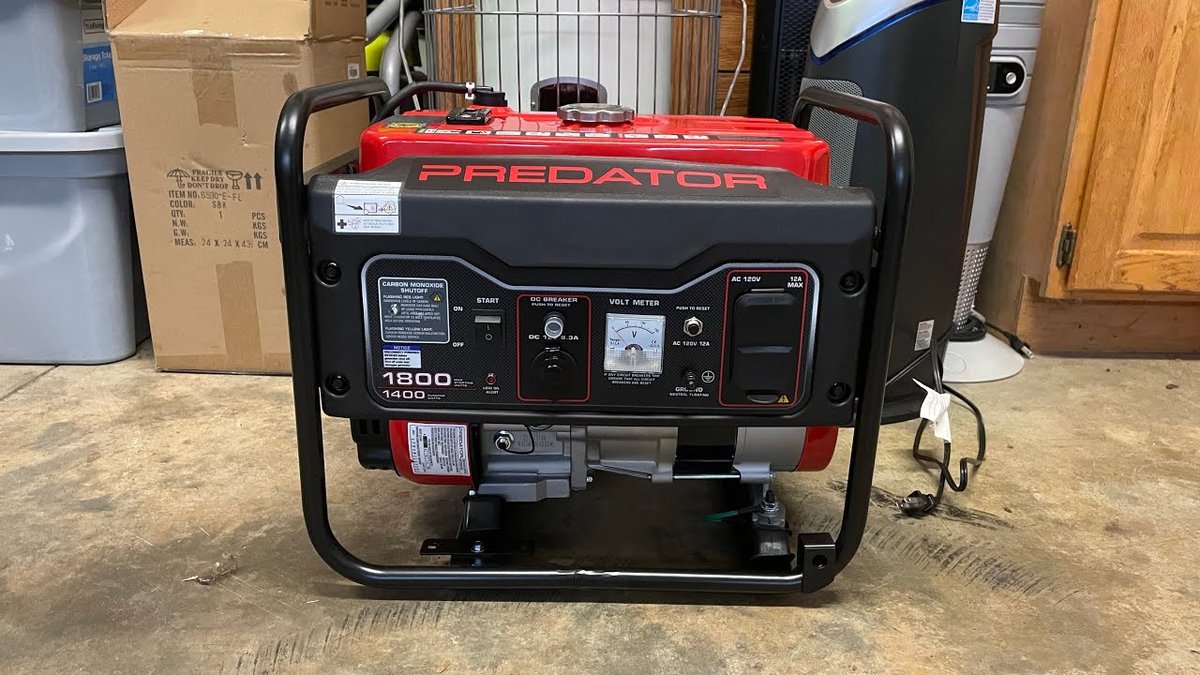
Stepping into the world of portable power, few generators command attention quite like the Predator 13000 Watt Generator. If you're looking to understand its capabilities, uncover its best applications, and master the critical art of power sizing, you've landed in the right place. This isn't just a guide; it's your definitive playbook to harnessing the immense power of the Predator 13000, ensuring your home, job site, or mobile operation runs smoothly, no matter what.
At a Glance: Your Power Playbook
- Serious Muscle: Delivers 13,000 peak watts and a robust 10,500 running watts, putting it in the heavy-duty league.
- Heart of the Beast: Powered by a smooth 670cc V-twin OHV gas engine, ensuring reliability and less vibration.
- Fuel for Thought: Features an 8.75-gallon tank, providing up to 9 hours of runtime at 50% load.
- Outlet Oasis: A versatile array of 120V and 240V outlets, including a 50A connection, ready for diverse needs.
- Home & Away: Ideal for whole-house backup (even central AC), heavy-duty construction, food trucks, and off-grid living.
- Smart Sizing is Key: Always calculate your total running watts plus the single largest starting watt requirement to match generator capacity.
- Tri-Fuel Option: Look for a tri-fuel variant or conversion kits for added flexibility with gasoline, propane, and natural gas.
- Maintenance Matters: Regular oil changes, filter checks, and proper storage are crucial for longevity.
- Bang for Buck: Offers professional-grade power at a price point significantly lower than comparable national brands.
Beyond the Box Score: What Makes the Predator 13000 Stand Out?
When you’re eyeing a generator of this caliber, you're not just looking for raw power; you're seeking reliability, versatility, and value. The Predator 13000 Watt Generator consistently delivers on all fronts, often punching above its weight class.
The Power Under the Hood
At its core, this is a heavy-duty portable generator designed to handle significant electrical loads. It boasts an impressive 13,000 peak/starting watts and a steadfast 10,500 running/continuous watts. That's enough juice to make a real difference during an outage or on a demanding job site.
Fueling this performance is a robust 670cc V-twin OHV gas engine. The V-twin configuration isn't just a spec; it means smoother operation and reduced vibration compared to single-cylinder designs, translating to a more pleasant user experience and potentially longer component life. With an 8.75-gallon fuel tank, you can expect up to 9 hours of continuous power at a 50% load, giving you substantial runtime between refills.
Connectivity is key, and the Predator 13000 doesn't disappoint. Its comprehensive control panel includes:
- Four 120V 20A GFCI outlets for standard appliances and tools.
- One 120V 30A twist-lock outlet.
- One 120/240V 30A twist-lock outlet.
- A powerful 120/240V 50A outlet, capable of handling transfer switch connections for whole-house backup or large commercial equipment.
Add in features like electric start (with recoil backup), Automatic Voltage Regulation (AVR) for stable power output, Low Oil Shutdown to protect the engine, and a digital hour meter for maintenance tracking, and you have a package built for serious work. And despite its 352-pound weight, the included wheel kit with 10″ never-flat tires and fold-down handles makes it surprisingly manageable for a generator of its size.
Why This Generator, Not Just Any Generator
What truly sets the Predator 13000 apart is its exceptional power-to-price ratio. While national brands might charge $2,500-$3,500 for comparable specifications, the Predator typically retails for $1,599-$1,999. This makes it an incredibly attractive option for budget-conscious buyers who refuse to compromise on power.
The robust full-wrap tubular steel frame protects its components, ready for the rigors of frequent use. It’s not just a powerhouse; it’s a smart investment for anyone needing reliable, high-wattage portable electricity. For a deeper dive into the specifics of this workhorse, you can always Learn more about Predator 13000.
Decoding Your Needs: The Art of Power Sizing
Getting the right generator isn't about guessing; it's about precision. The most common mistake people make is underestimating their power requirements. Properly sizing your generator means understanding the difference between starting and running watts, and accurately calculating your total load.
Watts Up? Starting vs. Running Power Explained
To truly understand generator sizing, you need to grasp two fundamental concepts:
- Running Watts (Continuous Watts): This is the consistent power your appliances or tools require to operate once they are up and running. Think of it as the sustained energy needed to keep the lights on, the refrigerator humming, or a saw cutting.
- Starting Watts (Surge Watts): This is the momentary, higher burst of power needed for motor-driven appliances to kick into gear. Items with electric motors, like air conditioners, refrigerators, well pumps, or power tools, briefly draw significantly more power at startup than during continuous operation. This surge can be 2-3 times their running wattage, sometimes even more.
Your generator must be able to meet both these demands. If it can't handle the starting surge of your largest motor, that appliance simply won't turn on, or it could trip the generator's breaker.
Your Sizing Blueprint: A Step-by-Step Guide
Don't let the numbers intimidate you. Follow this simple process to accurately size your generator:
- List Your Essentials: Make a comprehensive list of every device, appliance, or tool you absolutely need to power simultaneously. Be realistic – not everything needs to run at once.
- Find the Running Watts: For each item on your list, locate its running wattage. You can usually find this on the appliance's data plate, in the owner's manual, or sometimes through a quick online search. If you only see volts (V) and amps (A), use the formula:
Watts = Volts x Amps. - Sum Your Running Watts: Add up all the running watts for the items you want to power simultaneously. This is your Total Running Watts requirement.
- Identify the Largest Starting Wattage: Now, look at your list for motor-driven appliances. Determine which one has the highest additional starting wattage requirement above its running wattage. For example, if a refrigerator runs at 800 watts but needs 1600 watts to start, its additional starting wattage is 800 watts.
- Pro Tip: You only need to account for the single highest additional starting wattage because it's highly unlikely you'll start all your motor-driven appliances at the exact same millisecond. You'll typically start them one by one.
- Calculate Total Starting Watts Needed: Add your Total Running Watts (from step 3) to the single highest additional starting wattage (from step 4). This final number represents the absolute minimum starting watts your generator needs to provide.
Example Scenario:
Let's say you want to power:
- Refrigerator: 800 Running Watts, 1600 Starting Watts (additional 800 for starting)
- Lights (various): 500 Running Watts
- Well Pump: 1000 Running Watts, 2000 Starting Watts (additional 1000 for starting)
- Microwave: 1200 Running Watts
- TV & Internet Router: 200 Running Watts
- Total Running Watts: 800 + 500 + 1000 + 1200 + 200 = 3700 Running Watts
- Highest Additional Starting Watts:
- Refrigerator: 800 W
- Well Pump: 1000 W (This is the highest additional starting wattage)
- Total Starting Watts Needed: 3700 (Total Running) + 1000 (Well Pump Starting) = 4700 Starting Watts
In this example, a generator with at least 3700 running watts and 4700 starting watts would suffice. The Predator 13000, with its 10,500 running watts and 13,000 peak watts, would easily handle this scenario and much more.
A Quick Appliance Power Reference
To help you get started, here's a general idea of common appliance wattages. Always confirm with your specific appliance's label.
| Appliance/Tool | Running Watts (Avg.) | Starting Watts (Avg.) |
|---|---|---|
| Central AC (3-ton) | 3500-5000 | 10000-18000 |
| Electric Water Heater | 3000-5000 | 3000-5000 |
| Refrigerator | 600-800 | 1200-1600 |
| Freezer | 500-700 | 1000-1400 |
| Well Pump (1/2 HP) | 1000-1500 | 2000-3000 |
| Sump Pump (1/2 HP) | 800-1000 | 1600-2000 |
| Microwave (1000W) | 1000-1500 | 1000-1500 |
| Coffee Maker | 800-1500 | 800-1500 |
| Electric Stove Burner | 1500-2500 | 1500-2500 |
| Hair Dryer | 1200-1800 | 1200-1800 |
| Incandescent Lights | 60-100 (per bulb) | 60-100 |
| LED/CFL Lights | 10-20 (per bulb) | 10-20 |
| TV (50-inch LED) | 100-200 | 100-200 |
| Computer/Laptop | 50-200 | 50-200 |
| Circular Saw | 1500 | 2500 |
| Air Compressor (1 HP) | 1500 | 4500 |
| Electric Welder (140A) | 4000-7000 | 4000-7000 |
Unleashing the Beast: Predator 13000 Watt Generator Use Cases
The sheer power and versatile outlet configuration of the Predator 13000 make it a true multi-tool for electricity, capable of handling scenarios that smaller generators simply can't touch.
Home Sweet Home (During an Outage)
For homeowners, the Predator 13000 isn't just about keeping a few lights on; it's about maintaining a near-normal lifestyle when the grid goes down.
Essential Home Backup: Keeping the Lights On (and More)
With 10,500 running watts, this generator can power most essential systems in a typical home simultaneously. Imagine this: your refrigerator is humming, the freezer is safe, lights are on in key rooms, the internet router is live, and your TV is running. On top of that, you can power a well pump for water, a sump pump to prevent flooding, and still have room to run a microwave or coffee maker. It brings a profound sense of security and comfort during prolonged outages.
Tackling the Big Draws: Central AC and Electric Water Heaters
This is where the Predator 13000 truly shines for residential use. Many generators can't handle the massive starting wattage required by a central air conditioning unit or the continuous draw of an electric water heater. The Predator's 13,000 peak watts mean it can often kick-start a 3-ton central AC unit (check your specific unit's requirements, as AC sizing varies widely). And its high running wattage allows it to maintain either an AC or an electric water heater, alongside many other essential appliances. This capability dramatically enhances comfort and convenience during summer heat waves or winter cold snaps.
The Job Site Workhorse
Construction professionals demand consistent, reliable power for heavy-duty tools, and the Predator 13000 delivers. It's built for the rugged environment of a job site.
It can simultaneously handle:
- Large air compressors for pneumatic tools.
- Concrete mixers for foundation work.
- Multiple corded power tools like circular saws, miter saws, drills, and grinders running off various 120V GFCI outlets.
- 240V equipment such as portable welders, larger chop saws, or specialty equipment thanks to its 30A and 50A 120/240V outlets.
Its robust full-wrap frame and never-flat tires make it suitable for moving across rough terrain, an invaluable feature for any active construction project.
Powering Your Passion: Mobile Businesses & Events
For entrepreneurs on the go, consistent power is the lifeblood of their operation. Food trucks, mobile detailing services, outdoor event vendors, and remote pop-up shops can all benefit immensely.
The Predator 13000 can easily power:
- Commercial refrigeration units to keep food safe.
- Multiple cooking appliances like griddles, fryers, and ovens in a food truck.
- Lighting and sound systems for outdoor events or concerts.
- Air conditioning for comfort in enclosed mobile units.
- Specialized tools for mobile services.
Its substantial fuel tank allows for extended operation, crucial for events that last many hours.
Fields and Farms: Agricultural Applications
Remote agricultural settings often lack reliable grid power, making a powerful portable generator indispensable. The Predator 13000 fills this gap, empowering various farm operations.
It's excellent for:
- Water pumps for irrigation or livestock watering.
- Powering workshop equipment like air compressors, welders, and heavy-duty power tools for repairs and fabrication.
- Providing backup power for barns, milking parlors, or critical animal care systems.
- Running grain augers or other essential farm machinery where an extension cord can reach.
Its robust build and ability to handle high starting loads make it well-suited for the demanding nature of farm machinery.
Off the Grid, On the Power: Remote Living
For those embracing off-grid living or managing remote properties, the Predator 13000 offers comprehensive power solutions. It can serve as the primary power source or a robust backup for solar systems.
It provides ample power for:
- Charging battery banks in off-grid homes.
- Running all major household appliances (refrigerator, well pump, washing machine, etc.).
- Powering tools and equipment for property maintenance and construction in remote areas.
- Providing power for hunting cabins, remote cottages, or emergency shelters.
Its significant runtime allows for extended periods of comfort and functionality without grid reliance.
The Triple Threat: Tri-Fuel Advantage
While the standard Predator 13000 runs on gasoline, a significant upgrade or variant offers tri-fuel capability, meaning it can also run on Propane (LP) and Natural Gas. This added flexibility is a game-changer for many users.
Gas, Propane, Natural Gas: Why Multi-Fuel Matters
The ability to switch between fuel sources offers several key advantages:
- Disaster Preparedness: If gasoline is scarce or unavailable after an emergency, you have other options. Propane can be stored for extended periods without degradation, unlike gasoline.
- Extended Runtime: With a natural gas connection (if available), your generator can run indefinitely, bypassing the need for constant refueling. For propane, connecting multiple large tanks can provide days of uninterrupted power.
- Cleaner Operation: Propane and natural gas burn cleaner than gasoline, producing fewer emissions and potentially extending engine life by reducing carbon buildup.
- Better Cold Weather Starting: Propane often performs better in colder temperatures compared to gasoline.
- Convenience: Natural gas means no messy refueling, and propane tanks are easily transportable and widely available.
Converting a standard Predator 13000 to tri-fuel usually involves purchasing and installing a conversion kit, which typically adds $300-$500 to the overall cost but is a worthwhile investment for the increased versatility.
From Crate to Current: Setup, Operation & Maintenance Essentials
A powerful generator is only as good as its setup and care. Understanding the basics of getting your Predator 13000 running safely and keeping it in top condition is crucial for maximizing its lifespan and reliability.
First Firing: Getting Your Predator Ready
Before you even think about starting it up, a few key setup steps are required:
- Wheel Kit Installation: Attach the included 10″ never-flat tires and handles for mobility.
- Battery Connection: Connect the terminals to the electric start battery.
- Oil Up: Add 1.7 quarts of SAE 10W-30 oil to the crankcase. Never run the generator dry of oil.
- Fuel Fill: Fill the 8.75-gallon tank with fresh 87+ octane unleaded gasoline.
- Grounding: Properly ground the generator using a grounding rod and wire, especially when using a transfer switch. This is a critical safety step.
Once assembled and fueled, starting is straightforward: turn the electric key switch. For cold starts, engage the choke. If the battery is low, the manual recoil backup provides a reliable alternative.
Running Smoothly, Running Safely: Best Practices
Safe operation is paramount. Portable generators produce carbon monoxide, a colorless, odorless, and deadly gas.
- Outdoor Placement ONLY: Always operate the generator outdoors, at least 20 feet away from any windows, doors, or vents that could allow exhaust fumes to enter occupied spaces.
- Carbon Monoxide Monitoring: Install battery-operated carbon monoxide detectors in your home if using the generator for backup power.
- Fire Prevention: Ensure the generator is completely cool before refueling. Spilled fuel on a hot engine can ignite. Keep flammable materials away.
- Appropriate Extension Cords: Use heavy-duty, outdoor-rated extension cords that are properly rated for the power draw of your appliances. Avoid overloading cords.
- Transfer Switch for Home Backup: For whole-house power, a professionally installed manual transfer switch is essential. It safely isolates your home from the utility grid, preventing dangerous backfeed that could injure utility workers.
- Manage Your Loads: Start large, motor-driven appliances (like a refrigerator or AC) one at a time to avoid overloading the generator's starting watts.
- Cooling Clearance: Ensure at least 3 feet of clear space around the generator for adequate airflow and cooling.
- Daily Checks: Briefly check oil levels before each extended use.
Keeping It Kicking: Your Maintenance Checklist
Regular maintenance is the secret to extending your generator's lifespan.
- Before Each Use: Check oil level, air filter, and fuel level.
- After First 20 Hours: Change the engine oil and inspect the spark arrestor. This initial oil change removes break-in contaminants.
- Every 50 Hours / 3 Months:
- Change engine oil.
- Clean air filter.
- Clean fuel sediment cup.
- Inspect and clean spark plugs.
- Every 100 Hours / 6 Months:
- Perform all 50-hour tasks.
- Replace spark plugs (if needed).
- Clean fuel tank and fuel filter.
- Inspect fuel lines for cracks or damage.
- Annually / Every 300 Hours:
- Replace spark plugs and air filter.
- Clean the combustion chamber.
- Adjust valve clearance.
- Clean fuel lines and tank.
Storing Your Generator: Hibernate Safely
If you won't use the generator for an extended period:
- Fuel Stabilization: Add a fuel stabilizer to the tank and run the engine for a few minutes, or completely drain the fuel system (tank and carburetor) to prevent gumming.
- Oil Change: Perform an oil change.
- Cylinder Protection: Remove the spark plug and pour a tablespoon of oil into the cylinder, then slowly pull the recoil rope a few times to coat the cylinder walls. Reinstall the spark plug.
- Battery Care: Disconnect the battery and connect it to a trickle charger to maintain its charge.
- Cover Up: Use a fitted generator cover to protect it from dust, moisture, and debris.
Troubleshooting Tidbits: What to Do When It Hiccoughs
Even robust generators can occasionally have issues. Here are quick checks for common problems:
- Won't Start:
- No Fuel? Check the tank.
- Low Oil? The low oil shutdown system prevents starting.
- Dead Battery? Check connections, charge, or use recoil start.
- Spark Plug: Is it dirty, fouled, or improperly gapped?
- Choke: Is it in the correct position for a cold or warm start?
- Air Filter: Is it clogged?
- No Power Output:
- Tripped Breaker? Check the circuit breakers on the generator's control panel.
- Voltage Selector: Is it set to the correct 120V or 240V output?
- AVR Failure? (Less common, requires professional diagnosis).
- GFCI Tripped? Reset GFCI outlets.
- Rough Running/Engine Performance Issues:
- Stale Fuel? Use fresh, high-quality gasoline.
- Carburetor: Clogged or dirty (often from old fuel).
- Air Filter: Dirty, restricting airflow.
- Spark Plug: Worn or dirty.
- Altitude: Carburetor may need adjustment for high altitude use.
- Excessive Noise/Vibration:
- Loose Components: Check for loose bolts on the frame, engine, or muffler.
- Engine Mounts: Damaged or worn engine mounts.
- Exhaust System: Damage to the muffler or exhaust pipe.
The Long Haul: Cost of Ownership & Lifespan
Purchasing a generator is an investment, and understanding the long-term cost of ownership helps set realistic expectations.
Making the Purchase: What to Look For
The Predator 13000 is primarily available at Harbor Freight stores and online. When you receive it:
- Inspect for Damage: Check for any shipping damage immediately.
- Included Accessories: Confirm the wheel kit, tools, and user manual are all present. Note that engine oil is typically not included and must be purchased separately.
- Warranty: Understand the warranty terms and registration process.
Fueling Your Future: Consumption & Efficiency
Fuel consumption is a major operating cost. Here's what to expect for the Predator 13000 at 50% load:
- Gasoline: Approximately 1.0-1.2 gallons per hour.
- Propane (LP): Approximately 1.6-1.8 gallons per hour.
- Natural Gas: Approximately 170-200 cubic feet per hour.
These figures highlight why tri-fuel capability can be a cost-saver or a lifesaver depending on fuel availability and price.
Investing in Longevity: Maintenance Costs and Lifespan
With diligent maintenance, you can expect excellent longevity from your Predator 13000.
- Annual Maintenance Costs: Budget roughly $20-$30 for oil changes, $15-$25 for air filters and spark plugs, and $10-$15 for fuel filters. These small investments prevent costly repairs.
- Component Lifespan:
- Engine: 1,500-2,500 hours (with proper maintenance).
- Generator Components: 1,000-2,000 hours.
- Frame and Body: 10+ years.
Regular servicing is not just about keeping it running; it’s about protecting your investment and ensuring it's ready when you need it most.
What Users Are Saying: Praises and Practicalities
Real-world user feedback paints a clear picture of the Predator 13000. It's a powerful and popular choice, but like any heavy-duty machine, it comes with specific characteristics.
The Good, the Great, and the Grievances
Praises:
- Unbeatable Value: Consistently cited as its top selling point, offering professional power at an accessible price.
- Serious Power Capacity: Users confirm it handles whole-house loads, including large appliances, with ease.
- Smooth V-twin Engine: Appreciated for its reduced vibration and reliable performance.
- Versatile Outlets: The array of 120V and 240V options, especially the 50A, is a major plus for diverse applications.
- Fuel Efficiency: Considered reasonable for its power output, especially the gasoline runtime.
Practicalities (and minor criticisms): - Weight: At 352 pounds, it's a beast. While the wheel kit helps significantly, moving it requires effort.
- Noise Level: At 76-78 dB, it's noticeably loud. This is typical for open-frame generators of this size, but something to be aware of for residential use.
- Manual Clarity: Some users find the owner's manual could be more detailed or organized.
- Oil Change: The oil drain location can be a bit messy, requiring careful planning to avoid spills.
Who Is This Generator For? (And Who It Isn't)
The Predator 13000 is an excellent fit for:
- Homeowners needing reliable, whole-house backup power, including central AC and electric water heaters.
- Construction professionals requiring robust power for multiple heavy-duty tools and 240V equipment.
- Mobile businesses (food trucks, event vendors) that depend on consistent, high-wattage electricity.
- Agricultural operations needing power for pumps, workshops, and critical farm systems.
- Remote property owners or those living off-grid requiring comprehensive power solutions.
- Budget-conscious buyers who need serious power without the premium price tag of national brands.
It might not be the best choice for: - Those needing ultra-quiet operation (e.g., for quiet campsites or noise-sensitive areas).
- Users requiring small-scale power for only a few sensitive electronics (an inverter generator would be better).
- Individuals unable to manage its weight, even with the wheel kit.
- Anyone needing a compact generator for very tight storage spaces.
Your Next Step to Uninterrupted Power
Understanding the Predator 13000 Watt Generator's use cases and power sizing principles empowers you to make an informed decision. This heavy-duty workhorse offers incredible value and performance, making it a compelling choice for a wide range of demanding applications.
Whether you're safeguarding your home against outages, driving productivity on a job site, or keeping your mobile business thriving, the key is to precisely match its capabilities to your specific needs. Take the time to calculate your required wattage, consider the fuel options, and commit to the simple maintenance schedule. Do this, and you'll unlock years of reliable, uninterrupted power, giving you peace of mind and the electricity you need, when you need it most.